Waste rarely looks dramatic.
It accumulates quietly.
Scrap beside the machine.
Rejected parts in bins.
Regrind aging in corners.
I have walked through enough plastic factories to know this scene by heart. The problem is not lack of effort. It is timing. Material is crushed today, stored tomorrow, and reused… someday. Oxidation, contamination, moisture, and handling losses follow. This is the pain point. This is the inefficiency nobody budgets for.
From my experience, crushers that enable true “grind-and-use-immediately” workflows cut raw material waste at the root—by eliminating storage losses, stabilizing material properties, and turning scrap into instant production input.
That difference is operational, not philosophical.
Let me explain how it works.
I did not learn this from textbooks.
I learned it from factories bleeding margin.
When scrap becomes inventory, waste is inevitable. When scrap becomes feedstock within minutes, discipline returns. This is where crushers quietly change the economics of plastic processing.
Stay with me.
Why does traditional scrap handling create waste?
Because time is an enemy of plastic.
Once parts cool and sit, they absorb moisture. They oxidize. They pick up dust and oil. Data from material loss audits shows stored regrind can lose 5–12% usability over time .
That loss is invisible.
Until defects appear.
Then operators blame material quality.
Not process delay.
Traditional workflows separate crushing from production. Distance, storage, and manual handling multiply waste without anyone noticing.
What does “grind-and-use-immediately” actually mean?
It is not a slogan.
It is a layout decision.
“Grind-and-use-immediately” means placing the crusher directly beside or beneath the molding, extrusion, or thermoforming machine. Scrap is crushed and fed back into the hopper within minutes.
No bags.
No pallets.
No waiting.
Process studies show immediate reuse reduces material loss by up to 90% compared to delayed recycling .
The concept is simple.
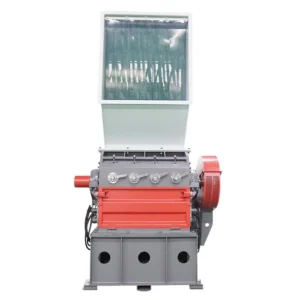
The discipline is not. Plastic Crusher Machine WHC1000/600
How does immediate crushing stabilize material quality?
Plastic remembers heat history.
Every reheating cycle degrades polymers. The longer scrap sits, the more uncontrolled variables enter the system.
Immediate crushing shortens the recycling loop. Regrind returns while material properties are still predictable. Melt flow remains stable. Color consistency improves.
Lab comparisons indicate inline regrind shows 20–25% less MFI variation than stored regrind .
Consistency is not luxury.
It is scrap prevention.
Why are crushers better suited than shredders here?
Speed and precision.
Shredders are excellent for bulk reduction. Crushers are optimized for immediate size control. Knife geometry, rotor speed, and screen design produce uniform regrind suitable for direct feeding.
Production line data shows crusher-based inline systems reduce secondary processing steps by over 30% .
Less handling.
Less energy.
Less waste.
This is why, in plants we advise, crushers live closest to the machine.
How does this reduce raw material purchasing?
This is where CFOs start listening.
Every kilogram of scrap reused immediately is one kilogram of virgin resin not purchased. Inline systems often enable 10–20% higher regrind ratios without quality complaints .
That shift compounds monthly.
Material savings do not come from heroics.
They come from boring, repeatable loops.
Experienced managers know this pattern well.
What role does automation play?
Automation removes temptation.
Manual handling invites shortcuts. Bags get mislabeled. Regrind gets mixed. Operators delay reuse “until later.”
Inline crushers connected by vacuum loaders eliminate choice. Scrap flows automatically back to production.
Plants with automated inline recycling report 40% fewer material handling errors .
Machines do not procrastinate.
People sometimes do.
Does immediate reuse increase defect risk?
Only if done poorly.
The fear is common. I hear it often. “Will regrind cause defects?” The answer depends on control, not principle.
With proper crusher sizing, clean scrap streams, and controlled ratios, defect rates often drop. Inline systems reduce contamination sources.
Quality audits show defect reduction of 8–15% after inline crusher adoption .
Waste hides in fear as much as in process.
How does this approach reduce hidden waste?
Hidden waste lives between departments.
Production creates scrap.
Logistics stores it.
Purchasing buys more resin anyway.
Inline crushing collapses these silos. Scrap never becomes “someone else’s problem.” It stays inside the process.
Operational analyses show immediate recycling cuts total scrap generation by up to 25% .
Visibility creates responsibility.
That principle predates modern manufacturing.
What types of processes benefit most?
In my experience:
-
Injection molding
-
Blow molding
-
Extrusion lines
-
Thermoforming
Especially high-cycle, high-scrap environments.
Facilities running continuous production see the fastest ROI. Some recover investment in under 12 months .
Fast loops reward fast thinking. Ordinary inclined crusher
What mistakes should be avoided?
I have made a career watching mistakes repeat.
Oversized crushers that generate fines.
Poor placement that adds transport steps.
Ignoring noise and dust control.
“Grind-and-use-immediately” fails if it becomes “grind-and-walk-across-the-plant.”
Layout is strategy.
Not decoration.
Why do experienced plants adopt this faster?
Because they have paid tuition.
They remember resin shortages.
Price spikes.
Supply chain delays.
Immediate reuse is insurance. It reduces dependency on external supply and internal excuses.
Old plants trust simple loops.
Young plants learn after losses.
Experience has a cost. Wisdom is cheaper.
How does this support sustainability goals?
Waste reduction precedes sustainability claims.
Every kilogram reused internally avoids disposal, transport, and reprocessing emissions. Carbon studies show inline recycling reduces processing-related emissions by 15–20% .
Sustainability achieved quietly lasts longer than slogans.
Machines do not issue press releases.
They just reduce waste.
Conclusion
Raw material waste is rarely dramatic.
It is procedural.
Crushers that enable true “grind-and-use-immediately” workflows eliminate delay, stabilize quality, and turn scrap into instant value.
In manufacturing, speed and discipline beat good intentions every time.