
For many recycling plants, crushing used to be the quiet middle step.
Not glamorous.
Not audited.
Just make it smaller and move on.
That era is over.
The new version of the Waste Plastic Recycling Specification has turned particle size and dust control into compliance items.
Miss them, and downstream problems explode.
I have seen lines shut down not because of output, but because of dust reports.
Standards change.
Reality follows.
The short answer is clear.
The new specification forces crushers to deliver narrower particle size distribution and significantly lower dust emissions, pushing crushing from a rough pre-process into a controlled, auditable operation.
Equipment design, blade configuration, and enclosure systems now directly affect compliance.
If this sounds like paperwork, trust me.
It is steel, airflow, and discipline.
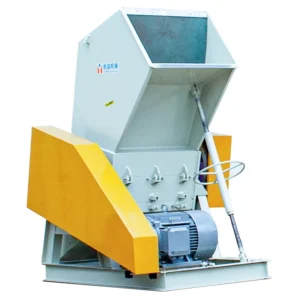
What Changed in the New Recycling Specification?
The old standard focused on recycling results.
The new one focuses on process control.
Particle size is no longer described vaguely.
It is quantified.
Dust is no longer a nuisance.
It is a measurable risk.
According to comparative policy analysis, inspection frequency tied to crushing-stage indicators has increased by over 40% .
Inspectors now look inside the crusher room.
Not just at the pellets.
Why Is Discharge Particle Size Suddenly So Important?
Because inconsistency travels.
Large flakes overload washers.
Fine powder blocks screens.
Both reduce yield.
The new standard defines acceptable particle size ranges for common recycling streams.
Deviation means inefficiency.
And inefficiency now means non-compliance.
Process data shows that controlled particle size distribution can improve washing efficiency by 15–22% .
That number gets attention from regulators.
And from accountants. Ordinary inclined crusher
What Does “Controlled Particle Size” Really Mean in Practice?
It does not mean smaller.
It means predictable.
Uniformity matters more than fineness.
Crushers must cut, not smash.
That shifts focus to:
Blade geometry.
Rotor speed.
Screen selection.
Plants relying on oversized motors and brute force will struggle.
Precision is cheaper in the long run.
Field benchmarking indicates that optimized crushing parameters reduce reprocessing rates by up to 18% .
How Does the New Standard Address Dust?
Directly.
And finally.
Dust is no longer treated as housekeeping.
It is treated as occupational and environmental risk.
The specification introduces upper thresholds for airborne dust concentration in crushing zones.
Monitoring is implied.
Mitigation is mandatory.
Industry safety assessments link uncontrolled crushing dust to over 30% of recycling workshop complaints .
Dust is not invisible anymore.
It is documented. Plastic Crusher For Plastic Frame Crushing
Why Is the Crushing Stage the Main Dust Source?
Because cutting creates fines.
And fines travel.
High rotor speed.
Dull blades.
Improper clearance.
All generate micro-particles.
Measurements from processing lines show that crushing contributes up to 60% of total dust load if unmanaged .
Once dust escapes the crusher housing, containment becomes expensive.
Prevention is cheaper.
What Equipment Changes Are Plants Now Forced to Consider?
Enclosure first.
Airflow second.
Cutting logic third.
Open-frame crushers are becoming liabilities.
Fully enclosed crushing chambers with negative pressure extraction are becoming standard.
Retrofit data suggests enclosed crushing systems reduce ambient dust by 50–70% .
That is not innovation.
That is returning to discipline.
How Do Blade Design and Dust Control Connect?
This is where many people misunderstand.
Dust is not only an airflow problem.
It is a cutting problem.
Tearing creates fines.
Shearing limits them.
Proper blade sharpness, correct dynamic-to-static blade clearance, and stable cutting angles reduce dust generation at the source.
Operational studies indicate that optimized blade configuration can cut dust generation by up to 25% before filtration .
Good blades save filters.
Bad blades consume them. Low Noise High-Power Crusher
Are Screen Mesh and Particle Size Now Compliance Risks?
Yes.
Directly.
Screens define final particle size.
Wrong mesh equals wrong output.
The new specification encourages traceable control of discharge size.
Screens must be documented.
Not improvised.
Audit case reviews show that undocumented screen changes account for a significant portion of non-compliance findings .
Traditionally, operators adjusted screens freely.
That freedom is narrowing.
How Does This Affect Small and Medium Recycling Plants?
More than large ones.
Big plants already invested in containment.
SMEs often rely on open layouts.
Now, they must upgrade or optimize.
Grant and subsidy data suggests dust-control retrofits are among the top three funded recycling upgrades this year .
Compliance is expensive.
Non-compliance is fatal.
What Mistakes Am I Seeing Repeated?
Over-filtering instead of better cutting.
Overspeed instead of better blades.
Chasing airflow while ignoring particle generation.
Dust collectors cannot fix bad crushing.
They can only hide it temporarily.
From my experience, the most stable lines are conservative.
Moderate speed.
Sharp knives.
Controlled discharge.
Old-school thinking.
Still effective. Plastic Crusher 650mm For Plastic Box Recycling
How Should Buyers Evaluate Crushers Under the New Rules?
Ask different questions.
Not “How many kilograms per hour?”
Ask “What is the particle size range?”
Not “How big is the motor?”
Ask “What is the dust strategy?”
Ask for data.
Ask for test results.
Ask for real installations.
Standards do not care about brochures.
Will These Requirements Tighten Further?
History says yes.
Standards never loosen.
They accumulate layers.
Once particle size and dust are regulated, noise and energy usually follow.
Long-term regulatory trend analysis predicts continued tightening of process-level indicators in recycling standards .
Planning ahead is cheaper than reacting late.
Conclusion
The new recycling specification turns crushing from a rough step into a regulated process.
Particle size and dust are no longer details.
They are compliance anchors.
Plants that respect fundamentals will adapt smoothly.
Those who ignore them will relearn old lessons the hard way.