Injection molding factories recycle runner scrap every day. It saves material costs, improves sustainability, and reduces waste. However, many manufacturers face an unexpected challenge after installing a plastic crusher—secondary contamination. Dust, metal particles, mixed plastics, oil residue, and improper handling can all reduce the quality of recycled material. During a recent technical seminar hosted by AMIGE, engineers, production managers, and plastics processing experts gathered to discuss practical methods for minimizing contamination during runner scrap crushing. One conclusion stood out above all others: clean regrind begins with a clean process.
The seminar concluded that reducing secondary contamination requires more than simply purchasing a high-quality crusher. It demands a complete system that combines enclosed crushing, dust extraction, intelligent material conveying, proper maintenance, standardized operating procedures, and strict material management. By controlling contamination at every stage, injection molding factories can significantly improve regrind quality, product consistency, and overall production efficiency.
Good recycled material is never created by accident.
It is created through discipline.
Every clean plastic pellet starts with a clean process.

Why Is Secondary Contamination Becoming a Bigger Issue?
Many injection molding companies are increasing the percentage of recycled runner scrap used in production.
This helps reduce:
- Raw material costs
- Plastic waste
- Carbon emissions
However, higher recycled content also requires higher material quality.
According to the Global Injection Molding Technology Forum, contamination is one of the primary causes of unstable product quality in recycled plastics.
Common contamination sources include:
- Dust
- Metal fragments
- Mixed polymers
- Lubricants
- Workshop debris
- Human handling errors
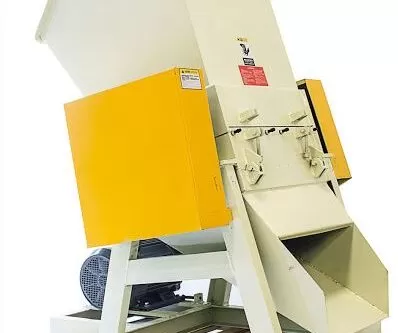
Small contaminants often create large production problems. FS1000 Plastic Crusher
What Happens When Runner Scrap Becomes Contaminated?
Poor-quality regrind affects every downstream process.
Potential consequences include:
- Black specks
- Surface defects
- Color inconsistency
- Reduced mechanical strength
- Increased reject rates
- Customer complaints
The International Polymer Quality Institute reports that contamination directly influences injection molding consistency and product performance.
One small contaminant can ruin an entire production batch.
Why Does Traditional Crushing Increase Contamination Risks?
Many conventional crushing systems operate as open systems.
While effective at size reduction, they often generate:
- Dust emissions
- Material leakage
- Airborne particles
- Noise pollution
These issues allow contaminants to enter recycled materials.
The crushing chamber itself may not be the problem.
The surrounding environment often is.
Clean material deserves a clean operating environment.
How Can Enclosed Crushing Systems Reduce Contamination?
One of the most discussed topics during the seminar was enclosed crushing technology.
A fully enclosed system minimizes material exposure during processing.
Benefits include:
- Lower dust generation
- Cleaner workshop conditions
- Reduced airborne contamination
- Better material containment
According to the Industrial Dust Control Association, enclosed processing systems significantly reduce contamination risks in plastics manufacturing.
Sometimes the best contamination control strategy is simply preventing contamination from entering in the first place.
Why Is Dust Collection Essential?
Dust appears harmless.
Until it enters molded products.
Fine dust particles may lead to:
- Cosmetic defects
- Reduced transparency
- Material contamination
- Machine wear
Modern dust control systems include:
- Cyclone separators
- Pulse dust collectors
- Negative-pressure extraction
- Central dust collection systems
The Advanced Manufacturing Environment Laboratory emphasizes that integrated dust collection improves both product quality and workplace safety.
Clean air usually means clean material.
Both are worth protecting.
Can Low-Speed Crushers Produce Cleaner Regrind?
This question generated considerable discussion.
The answer is often yes.
Compared with traditional high-speed crushers, low-speed granulators generally produce:
- Less dust
- Lower heat generation
- Reduced material degradation
- Quieter operation
Lower rotor speed helps preserve material properties while minimizing airborne particles.
According to the Plastic Processing Technology Institute, low-speed crushing technologies contribute to improved recycled material quality.
Sometimes slower creates better results.
Especially in plastics processing.
How Does Material Separation Improve Product Quality?
Mixing different polymers creates major quality risks.
Examples include:
- PP mixed with ABS
- PC mixed with PMMA
- Colored resin mixed with natural resin
These mistakes often result in:
- Product defects
- Processing instability
- Material waste
Seminar experts recommended:
Dedicated Material Containers
Separate every resin type.
Color Identification Systems
Simple visual management reduces errors.
Closed Material Conveying
Reduce manual handling.
Organization is one of the cheapest quality control tools available.
Why Does Equipment Maintenance Matter?
Even excellent equipment can become a contamination source if maintenance is neglected.
Routine inspections should include:
- Blade condition
- Screen cleanliness
- Bearing lubrication
- Fastener inspection
- Seal integrity
- Chamber cleaning
The Global Equipment Reliability Association highlights preventive maintenance as an essential part of contamination control.
A dirty machine rarely produces clean material.
Maintenance protects quality.
How Can Automation Reduce Human Error?
Automation minimizes unnecessary material handling.
This reduces contamination opportunities.
Useful technologies include:
- Automatic conveying
- Central feeding systems
- Closed-loop material transfer
- Smart material identification
The Smart Manufacturing Research Center reports that automated material handling improves production consistency while reducing contamination risks.
Automation does not replace operators.
It helps them make fewer mistakes.
What Best Practices Emerged from the Technical Seminar?
After extensive discussion, participants agreed on several recommendations:
- Use enclosed crushing systems.
- Install efficient dust collection.
- Consider low-speed granulators.
- Separate different plastic materials.
- Maintain equipment regularly.
- Minimize manual material handling.
- Train operators continuously.
- Monitor contamination sources routinely.
None of these practices are particularly complicated.
Together, however, they create significant improvements.
Why Will Contamination Control Become Even More Important?
The plastics industry continues evolving.
Manufacturers increasingly demand:
- Higher recycled content
- Better product quality
- Lower production costs
- Greater sustainability
These trends make contamination control increasingly valuable.
Factories capable of producing consistently clean regrind will enjoy stronger competitive advantages.
Quality begins long before injection molding.
It begins during recycling.
How Is AMIGE Supporting Cleaner Injection Molding Recycling?
At AMIGE, we continue improving our crushing technologies through:
- Low-dust crushing systems
- Optimized rotor designs
- Intelligent control systems
- Enclosed material handling
- Easy-maintenance structures
Our goal extends beyond building crushers.
We help customers build cleaner production systems.
Because cleaner recycling creates better manufacturing.
Conclusion
Our technical seminar demonstrated that reducing secondary contamination during runner scrap crushing requires a combination of advanced equipment, effective dust control, preventive maintenance, proper material management, and operator training. At AMIGE, we believe that every kilogram of clean regrind begins with intelligent crushing technology and disciplined production practices.
#InjectionMolding #PlasticCrusher #PlasticGranulator
#PlasticRecycling #RegrindMaterial #PlasticProcessing
#DustFreeProduction #IndustrialAutomation #PlasticMachinery
#AMIGE