A modular plastic crushing system allows a recycler to add capacity or downstream steps in planned stages. Modularity is not simply placing separate machines in a row. Each interface must preserve material flow, safety, controls, utilities and access as the plant changes.
I recommend drawing the current and future process before choosing the first module. The initial purchase should solve today’s bottleneck without creating an expensive barrier to the next expansion stage.
Map Current Flow and Future Interfaces
| System stage | Current decision | Future interface to reserve |
|---|---|---|
| Receiving and sorting | Feed form, contaminants and storage | Space for improved separation or metering |
| Primary size reduction | Need for shredder or direct crusher feed | Transfer height and controlled discharge |
| Granulation | Chamber, rotor, screen and usable capacity | Conveyor, dust and metal-removal connection |
| Intermediate storage | Buffer volume and batch identity | Connection to washing or pelletizing |
| Controls | Local interlocks and emergency stops | Signals for coordinated line control |
| Utilities | Installed power, air and water where required | Capacity for approved future equipment |
Size Modules Around the System Bottleneck
Nameplate capacity does not describe usable line output. The slowest transfer, screen, separator, storage step or downstream machine can limit the whole system. Test representative material and record feed rate, usable discharge, recirculation, stoppages and changeover time.
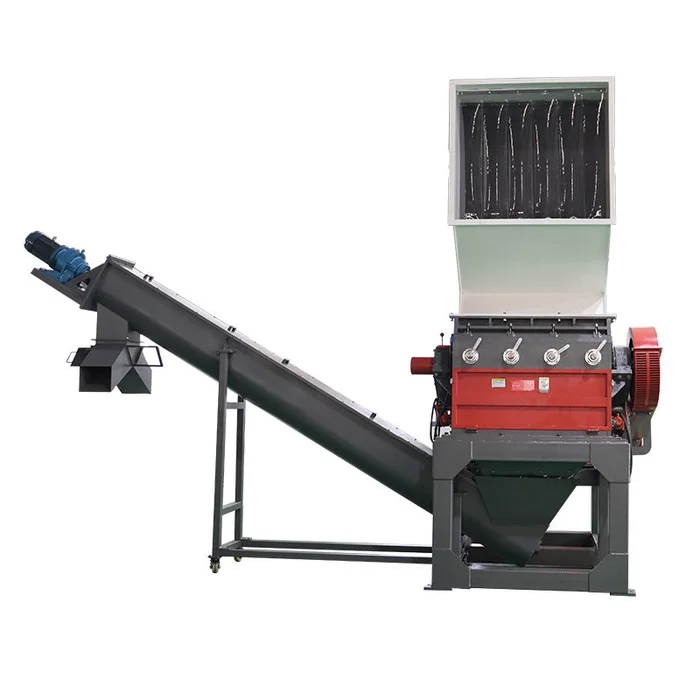
The WHC1200/600 heavy-duty plastic crusher with screw conveyor can be considered where controlled discharge is part of the layout. Bulky or irregular feed may instead require a single-shaft shredder before final granulation.
Define Controls, Installation and Expansion Boundaries
- Document start, stop, alarm and upstream or downstream interlocks.
- Reserve safe access for screens, blades, belts and cleaning.
- Confirm floor loading, anchor points and conveyor elevations.
- Identify dust, noise and metal-removal requirements.
- Label product, reject and rework paths.
- Record which future interfaces are prepared and which require redesign.
A modular system still needs one responsible process owner. The buyer should define who validates interfaces when equipment from several stages or suppliers is connected.
Frequently Asked Questions
Is modular equipment automatically compatible?
No. Capacity, height, controls, discharge, utilities and safety interfaces must be engineered for the specific combination.
When is a shredder needed before a crusher?
It may be needed for bulky, thick, irregular or difficult-to-feed material that cannot enter the crusher safely and consistently.
How much future capacity should be reserved?
Use an approved expansion scenario based on feed supply, shifts, downstream demand, utilities and floor space rather than an arbitrary percentage.
Can a new module connect to an existing line?
Yes when the material, capacity, mechanical, electrical, control and safety interfaces are verified before purchase.
What should be sent for a modular-line proposal?
Send the current layout, equipment list, material, hourly flow, bottleneck, utilities, target output and planned future stages.
Request an Expansion-Flow Review
Use the AMIGE inquiry page to provide the existing process and proposed expansion. We can map the material flow and interface requirements before recommending modules.