The automotive recycling industry is entering a new era. As more vehicles reach the end of their service life, dismantling companies are under increasing pressure to recover plastics efficiently while meeting strict environmental regulations. Components such as PP bumpers, ABS dashboards, interior trims, and mixed automotive plastics contain significant recycling value, but only when processed correctly. At AMIGE, we believe that advanced recycling technology transforms end-of-life vehicles into valuable raw materials. That belief recently became reality as our automotive bumper and dashboard crushing & washing line officially entered commercial operation at a customer facility in Poland.
The successful startup of our automotive plastic recycling line in Poland demonstrates how integrated shredding, crushing, washing, friction cleaning, density separation, drying, and intelligent automation can efficiently process complex automotive plastics. The system delivers clean, high-quality recycled flakes suitable for pelletizing and reuse, helping dismantling companies improve profitability while supporting the circular economy and reducing environmental impact.
Every recycled bumper tells a story.
It once protected a vehicle.
Today, it becomes raw material for the next generation of products.
That is the true meaning of circular manufacturing.
Why Is Automotive Plastic Recycling Growing So Quickly?
Modern vehicles contain more plastic than ever before.
Manufacturers use plastics to reduce vehicle weight, improve fuel efficiency, and increase design flexibility.
As a result, dismantling facilities now recover large quantities of:
- PP bumpers
- ABS dashboards
- Interior trims
- Wheel arch liners
- Plastic fuel tanks
- Door panels
- Air duct components
According to the Global End-of-Life Vehicle Recycling Report, plastic recovery has become one of the fastest-growing segments in automotive recycling.
Vehicles are no longer just metal.
They are valuable plastic resources.
Why Did the Polish Customer Invest in This Project?
The customer wanted to increase both processing capacity and recycled material quality.
Their objectives included:
- Higher throughput
- Cleaner plastic flakes
- Lower labor costs
- Stable continuous production
- Better resale value
Rather than purchasing separate machines, they selected a complete AMIGE recycling line.
An integrated system delivers greater efficiency than isolated equipment.
Which Automotive Plastics Can the Production Line Process?
The line is designed for a wide variety of vehicle components.
Typical materials include:
- PP bumpers
- ABS dashboards
- PP/EPDM automotive parts
- Plastic grilles
- Interior panels
- Door trims
- Plastic covers
- Mixed rigid automotive plastics
Its flexible design allows processors to handle materials from multiple vehicle manufacturers.
Versatility improves plant utilization throughout the year. Plastic Washing Machine PET Bottle Plastic Bottle Recycling Machine
What Are the Main Processing Stages?
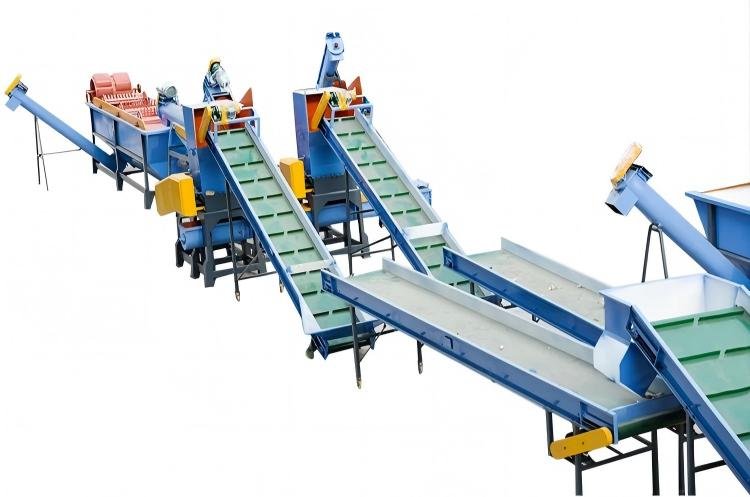
The recycling system combines multiple technologies into one complete production line.
Major processing stages include:
- Belt conveyor feeding
- Heavy-duty plastic crusher
- Friction washing
- Floating washing tank
- Density separation
- High-speed dewatering
- Hot-air drying
- Material storage
Each stage prepares material for the next.
Together, they produce high-purity recycled flakes.
According to the International Automotive Recycling Technology Center, integrated recycling systems significantly improve material quality and operational efficiency.
Why Is Crushing So Important?
Automotive components vary greatly in size and shape.
Efficient crushing provides:
- Uniform particle size
- Better washing efficiency
- Stable material flow
- Improved drying performance
- Easier downstream pelletizing
A properly designed crushing system reduces unnecessary energy consumption while improving production stability.
Good washing starts with good crushing.
How Does the Washing System Improve Material Quality?
Automotive plastics often contain:
- Dust
- Paint residues
- Labels
- Grease
- Adhesives
- Road contaminants
Our washing section combines several cleaning technologies to remove these impurities efficiently.
Benefits include:
- Cleaner flakes
- Lower contamination
- Higher pellet quality
- Increased material value
Clean recycled plastic commands stronger market demand.
Why Is Density Separation Necessary?
Different automotive plastics have different densities.
The floating separation system removes unwanted contaminants by separating:
- Heavy materials
- Light plastics
- Residual impurities
This stage improves:
- Product purity
- Sorting accuracy
- Recycling efficiency
Material purity directly influences final product value.
The cleaner the flakes, the higher the return.
How Does Automation Improve Plant Performance?
Modern recycling facilities require intelligent control systems.
The PLC system manages:
- Material feeding
- Motor synchronization
- Water circulation
- Equipment protection
- Alarm monitoring
- Production data
According to the Industrial Automation Research Alliance, intelligent automation improves production stability while reducing labor intensity.
Automation creates consistency.
Consistency creates profitability.
What Benefits Has the Customer Achieved?
Since commissioning, the customer has reported:
- Stable production
- Higher throughput
- Lower maintenance frequency
- Cleaner recycled flakes
- Improved operational efficiency
- Better market competitiveness
The project also reduced manual handling and improved overall process control.
Reliable equipment builds reliable business performance.
How Does This Project Support Sustainability?
Every recycled automotive component reduces demand for virgin plastic.
That contributes to:
- Lower carbon emissions
- Reduced landfill waste
- Improved resource efficiency
- Circular manufacturing
The Global Circular Automotive Materials Institute highlights automotive plastic recycling as an increasingly important contributor to carbon reduction strategies.
Every recycled bumper saves more than plastic.
It saves resources.
Why Does AMIGE Continue Investing in Automotive Recycling Solutions?
The automotive recycling industry continues evolving rapidly.
At AMIGE, we continuously improve:
- Heavy-duty crushers
- Intelligent washing systems
- Energy-efficient motors
- Automated controls
- Customized recycling solutions
Our objective is simple.
Help customers recover more valuable materials with greater efficiency and lower operating costs.
Technology creates opportunity.
Engineering turns opportunity into results.
What Does the Future Hold?
As electric vehicles and lightweight automotive materials continue expanding, plastic recovery will become even more important.
Future recycling plants will increasingly integrate:
- AI-assisted sorting
- Intelligent monitoring
- Automated quality control
- Energy-efficient processing
- Digital production management
The future of automotive recycling belongs to companies that combine innovation with reliable engineering.
At AMIGE, we are proud to be part of that future.
Conclusion
The successful commissioning of our automotive bumper and dashboard crushing & washing line in Poland demonstrates AMIGE’s commitment to advanced recycling technology, intelligent manufacturing, and long-term customer success. By delivering efficient crushing, thorough washing, automated control, and reliable operation, we help automotive recyclers recover valuable plastics, improve profitability, and contribute to a more sustainable circular economy.
#AutomotiveRecycling
#PlasticRecycling
#PlasticCrusher
#PlasticWashingLine
#CarBumperRecycling
#DashboardRecycling
#RecyclingEquipment
#CircularEconomy
#PlasticMachinery
#AMIGE