How It Works: The Process
This machine uses mechanical crushing and air separation rather than burning or chemicals, which is better for the environment (and your lungs).
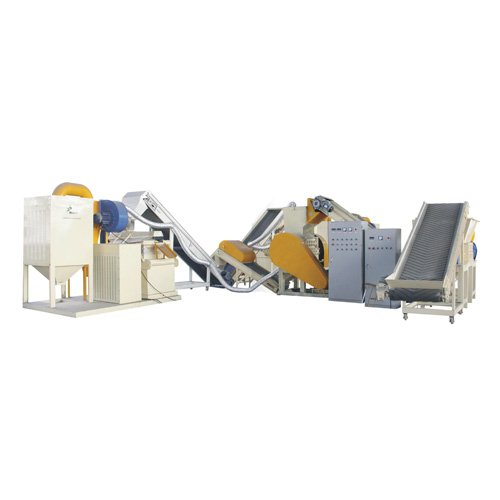
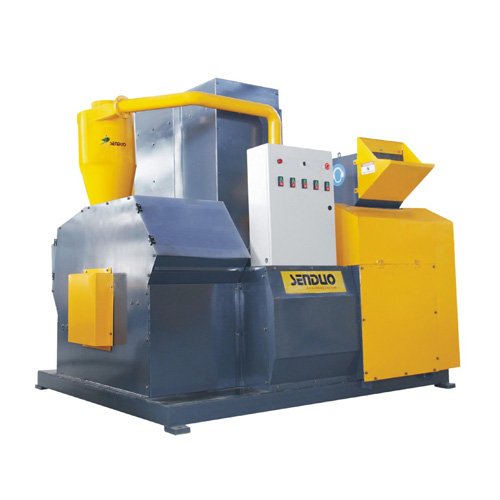
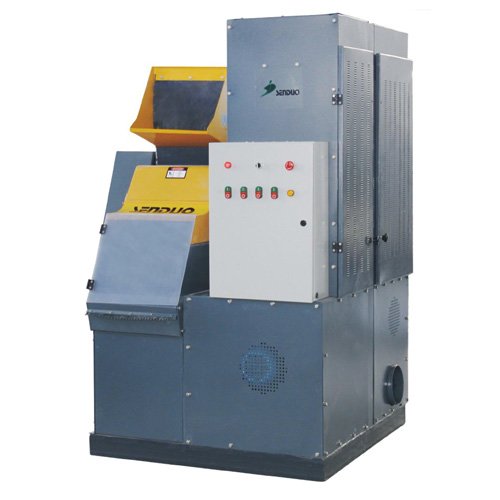
Crushing/Shredding: Scrap wires are fed into the yellow hopper. Inside, high-speed rotating blades chop the cables into small granules.
Air Separation: A high-pressure fan blows through the mixture. Since copper is much denser than plastic, the air lifts the lighter plastic bits while the heavy copper stays down.
Vibration Sifting: The machine uses a vibrating screen (often called a gravity table) to further refine the separation, ensuring the copper and plastic exit through different outlets.
Dust Collection: The large grey box structure on the right houses a filtration system to keep the workspace clean.
Key Features
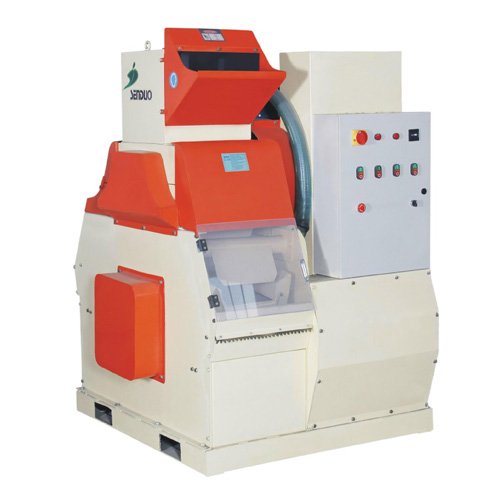
Control Panel: The white box with the buttons is the PLC (Programmable Logic Controller) or manual control hub. It allows the operator to adjust the vibration frequency and air blower speed.
Compact Design: This is an “all-in-one” unit, meaning the crusher, separator, and dust collector are integrated into one footprint for easier transport and setup.
Safety Guards: Notice the clear shielding and emergency stop buttons—essential for high-torque machinery like this.
QJ-400S01 scrap copper seprator & ranulator :Compact structure,Appearance of novel,Power saving,Stable performance,Once feeding,the single machine to complete, effective separation, with a good dust collection system.
| MODEL | POWER | VOLTAGE | ANGLE | BLADES | OUTPUT | SIZE | WEIGHT |
| QJ-400S01 | 11.92KW | 380V | 0.5-20mm | 10-2 | 80-120KG/H | 145*133*210cm | 900KG |