Shredder blade angle selection should begin with the material and cutting system, not a universal degree value. The same geometry can engage a rigid lump, hollow part, film bundle or fibrous feed differently because thickness, toughness, elasticity and contamination change the cutting load.
I recommend evaluating angle together with hook profile, knife thickness, rotor speed, counter-knife position, clearance and drive protection. A blade drawing alone cannot predict production performance.
Define Material Behavior Before Comparing Angles
| Feed behavior | Cutting concern | Test observation |
|---|---|---|
| Rigid thick parts | Impact, bite depth and peak load | Engagement, reversals and blade-edge condition |
| Hollow mouldings | Part movement and inconsistent presentation | Grab behavior and chamber stability |
| Flexible film or bags | Wrapping, tearing and low bulk density | Rotor clearing and usable discharge |
| Fibrous material | Pulling, winding and incomplete cut | Cut quality and buildup around the rotor |
| Abrasive reinforced plastic | Edge wear and heat | Wear pattern before and after the trial |
| Mixed or contaminated feed | Unexpected impact and damage | Separation limits and overload response |
Compare Geometry Under the Same Test Conditions
Use the same representative feed batch, screen, rotor speed, counter-knife setting and sampling method when comparing blade options. Record usable output, oversize, fines, reversals, motor-load trend, heat and any wrapping or bridging. Without controlled conditions, differences cannot be attributed to the blade angle.
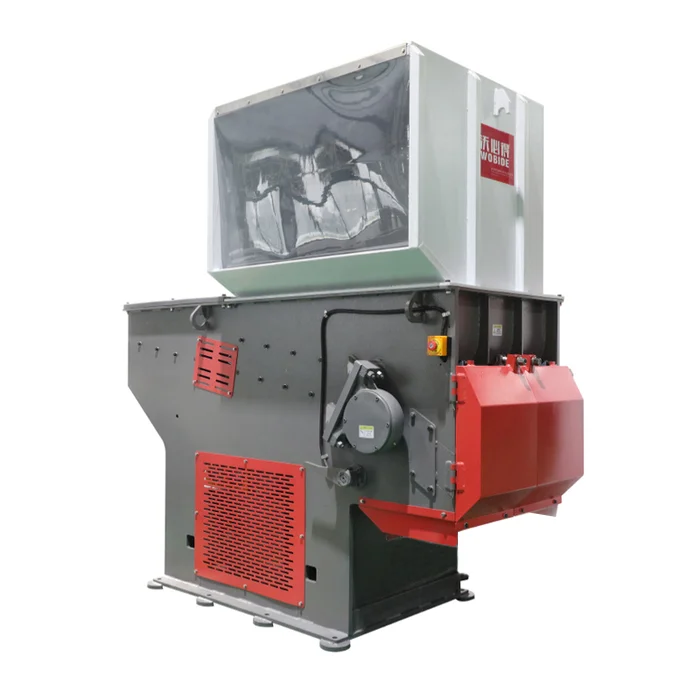
The WPS800 plastic recycling shredder can be reviewed with application-specific knives, but the final geometry must be matched to the intended feed and downstream size requirement.
Inspect Wear, Service Access and Repeatability
- Record the starting edge, clearance and fastener condition.
- Inspect chipping, rounding, polishing and material buildup.
- Confirm whether knives can be rotated, sharpened or replaced.
- Check the reference used to restore alignment after service.
- Link every blade set to material and operating records.
- Compare lifecycle cost rather than blade price alone.
A geometry that cuts well but is difficult to maintain may not be the best plant choice. Procurement should include service tooling, spare knives, safe access and the acceptance method.
Frequently Asked Questions
Is there one best shredder blade angle?
No. Material behavior, rotor design, knife profile, clearance, screen and duty cycle determine the suitable geometry.
Can blade angle alone reduce energy use?
No. Feed consistency, knife condition, rotor speed, recirculation and the complete drive system also affect energy and throughput.
Why should wear patterns be recorded?
They help identify abrasion, impact, alignment or contamination problems and support a repeatable maintenance decision.
Should the buyer request exact blade drawings?
Request enough dimensional and service information to verify compatibility, maintenance and spares while respecting the supplier’s controlled design documents.
What should be sent for blade selection?
Send material, photos, maximum dimensions, thickness, contaminants, hourly volume, target output and current wear problems.
Request a Cutting-Geometry Review
Use the AMIGE inquiry page to provide representative feed and the required output. We can define the blade, counter-knife and test conditions before configuration.