Extreme Crusher Test: Can AMIGE Blades Stay Stable When Crushing Hard Glass-Fiber-Reinforced Nylon?

Taizhou Amige Machinery Co.,Ltd

Hard engineering plastics can make an ordinary plastic crusher look impressive for the first few minutes—and exhausted soon afterward. Glass-fiber-reinforced nylon is a perfect example. It is hard, abrasive, mechanically strong, and far less forgiving than normal PE or PP scrap. Poor blade material quickly loses its edge. An unsuitable rotor creates impact and vibration. Rising cutting resistance pushes motor load higher. For a recycling factory, the result can be frequent blade sharpening, unstable output, higher electricity consumption, and expensive downtime. So at AMIGE, we decided to give our crusher a tougher assignment.

During our latest extreme material test, we challenged an AMIGE heavy-duty plastic crusher with hard glass-fiber-reinforced nylon scrap. The objective was not simply to see whether the machine could break the material. We wanted to observe blade stability, cutting performance, motor load, vibration, discharge consistency, and wear behavior under a highly abrasive application. The crusher maintained stable operation throughout the test, demonstrating why blade material, rotor structure, cutting geometry, and overall machine rigidity must be engineered as one complete system.

Anyone can crush an easy plastic.

The interesting question begins when the material starts fighting back.

That is where machine quality becomes visible.

Why Is Glass-Fiber-Reinforced Nylon So Difficult to Crush?

Nylon itself is already an engineering plastic.

PA6 and PA66 are widely used because they can provide excellent:

  • Mechanical strength
  • Wear resistance
  • Fatigue resistance
  • Heat resistance
  • Chemical resistance

Manufacturers frequently add glass fiber to further improve stiffness, dimensional stability, and mechanical properties.

Common formulations include materials such as:

  • PA6-GF15
  • PA6-GF30
  • PA6-GF40
  • PA66-GF30
  • PA66-GF50

The number generally indicates the approximate percentage of glass-fiber reinforcement.

According to this engineering plastics material reference, increasing glass-fiber content can significantly change stiffness, strength, processing behavior, and abrasion characteristics.

For a crusher, that changes everything.

We are no longer cutting ordinary plastic.

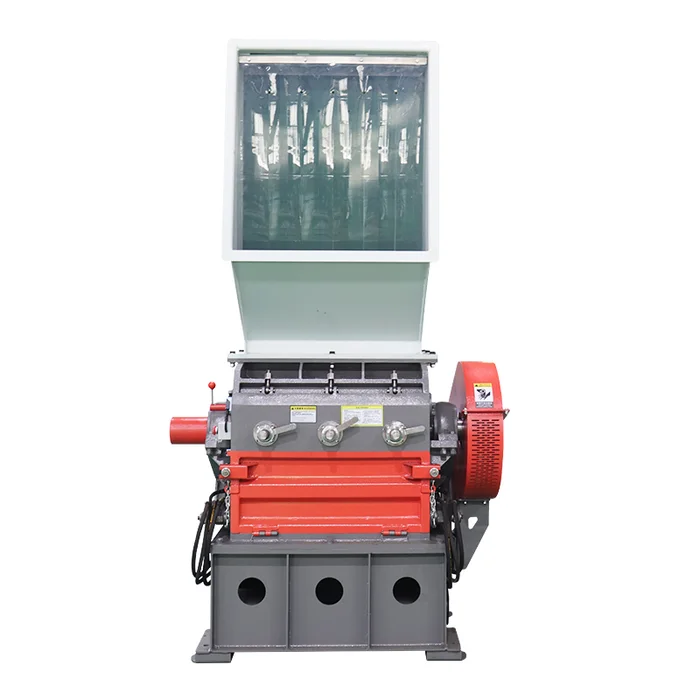
We are cutting plastic containing abrasive reinforcement. Industrial Plastic Waste Crusher WHC800/450

Where Does Glass-Fiber-Reinforced Nylon Waste Come From?

Glass-filled nylon is common in demanding industrial applications.

Typical waste sources include:

  • Automotive components
  • Electrical housings
  • Electronic connectors
  • Power-tool components
  • Industrial gears
  • Bearing housings
  • Mechanical parts
  • Injection molding runners
  • Sprues
  • Rejected molded products

Many factories generate this material continuously.

That creates an attractive recycling opportunity.

But the material needs to be reduced to a suitable size before further processing or reuse.

For relatively small injection molding scrap, a heavy-duty crusher may handle the material directly.

For large or thick components, we may recommend:

Shredder → Conveyor → Heavy-Duty Crusher

The correct solution depends on the material dimensions, thickness, glass-fiber percentage, required throughput, and final particle size.

What Exactly Were We Testing?

A machine test should answer engineering questions.

Otherwise, it is only a video.

During this type of hard-material crushing test, our attention focuses on several areas.

Cutting Stability

Does the rotor maintain smooth cutting?

Blade Condition

Does the cutting edge show abnormal chipping or rapid wear?

Motor Load

Does current remain reasonably stable?

Machine Vibration

Does the crusher experience excessive impact?

Feeding Behavior

Can the material enter the cutting chamber consistently?

Output Condition

Is the crushed material reasonably uniform?

Temperature

Does continuous cutting generate excessive heat?

These indicators tell us much more than simply measuring whether material comes out of the discharge conveyor.

Why Are Crusher Blades Critical for Reinforced Nylon?

Think about the contact point.

The entire machine may weigh hundreds or thousands of kilograms.

But the actual cutting occurs along a relatively small blade edge.

That edge receives repeated impact and abrasion.

For glass-filled engineering plastics, blade properties become particularly important.

We consider:

  • Hardness
  • Toughness
  • Wear resistance
  • Edge retention
  • Heat-treatment quality

Depending on the application, tool steels such as D2 or DC53 may be evaluated.

But I never recommend selecting a blade based on hardness alone.

The hardest knife is not automatically the best knife.

Too soft?

Rapid wear.

Too brittle?

Chipping risk.

The goal is balance.

Why Does Heat Treatment Matter as Much as Steel Grade?

Customers sometimes ask me:

“Which blade material do you use?”

That is an important question.

But it is only half the question.

The next question should be:

“How is it heat-treated?”

Two blades made from nominally similar steel can perform differently because of:

  • Heat-treatment process
  • Hardness distribution
  • Internal stress
  • Grinding quality
  • Edge geometry

The Industrial Tool Steel Performance Guide discusses the relationship between tool-steel heat treatment, toughness, hardness, and wear performance.

At AMIGE, we evaluate the blade as part of the cutting system.

A specification written on paper does not crush plastic.

The actual knife does.

How Does Rotor Design Affect Hard-Material Crushing?

Blade quality alone cannot rescue a badly designed rotor.

The rotor determines how material meets the knives.

A properly engineered rotor can help create:

  • Controlled cutting
  • Stable material engagement
  • Reduced unnecessary impact
  • Consistent load distribution
  • Efficient discharge

For hard reinforced plastics, aggressive uncontrolled impact can increase:

  • Noise
  • Vibration
  • Blade stress
  • Bearing load
  • Energy consumption

We therefore match rotor configuration to material characteristics.

This is one reason I always ask customers for material photographs and videos before recommending a crusher.

Better still, send us samples.

Plastic has many personalities.

A photograph introduces us.

A test tells us the truth.

Why Is Machine Rigidity Important?

Hard materials create reaction forces.

Those forces must go somewhere.

A heavy-duty crusher therefore requires a strong structural foundation.

Important areas include:

  • Cutting chamber
  • Rotor
  • Shaft
  • Bearing housings
  • Machine frame
  • Blade mounting system

Insufficient rigidity can contribute to vibration and reduce cutting stability.

Over time, repeated vibration may also affect components outside the cutting chamber.

For this reason, I do not evaluate a crusher only by motor kilowatts.

A larger motor attached to a weak structure is not heavy-duty engineering.

It is optimism with a power cable.

What Did We Observe During the Extreme Test?

During our reinforced-nylon test, the AMIGE crusher maintained stable material engagement.

The cutting action remained controlled.

We paid particular attention to the blades because this material was deliberately selected to challenge wear resistance.

The blades remained stable throughout the test without the abnormal damage that would indicate an unsuitable cutting configuration.

Material discharged continuously through the screen.

Machine operation also remained stable without the type of excessive vibration that can indicate uncontrolled impact.

This is exactly what we wanted to evaluate.

Not spectacular destruction.

Controlled size reduction.

For an industrial recycler, controlled production is far more valuable than a dramatic testing video.

Does Stable Blade Performance Mean the Blades Never Wear?

Absolutely not.

Every cutting tool wears.

Anyone promising a blade that never wears should probably also sell perpetual-motion machines.

Glass fiber is abrasive.

The objective is therefore not eliminating wear.

It is controlling wear economically.

A professional recycling operation should monitor:

  • Cutting-edge condition
  • Sharpening intervals
  • Blade clearance
  • Motor current
  • Throughput
  • Particle quality

When cutting efficiency starts declining, maintenance should be performed before performance deteriorates severely.

According to this industrial cutting wear reference, preventive blade inspection can help maintain more consistent size-reduction performance.

Good maintenance costs money.

Bad maintenance costs more.

How Does Blade Clearance Affect Crushing Performance?

Blade clearance is another detail that deserves attention.

If the clearance is unsuitable, several problems may occur:

  • Reduced cutting efficiency
  • Increased material tearing
  • Higher energy consumption
  • Irregular particles
  • Additional blade stress

The correct setting depends on:

  • Material type
  • Blade geometry
  • Machine design
  • Required particle size

For hard engineering plastics, precise blade installation becomes particularly important.

After sharpening or replacing knives, technicians should restore the recommended clearance rather than relying on guesswork.

A few millimeters—or sometimes much less—can influence an entire production shift.

Why Should We Monitor Energy Consumption per Ton?

A crusher may run successfully while still wasting energy.

That is why I prefer measuring:

kWh per ton

rather than looking only at installed motor power.

Suppose two crushers both process reinforced nylon.

Machine A uses less motor power but processes material slowly.

Machine B has higher installed power but produces substantially more material per hour.

Which one is more efficient?

You cannot answer until you calculate energy per ton.

The Industrial Size Reduction Energy Benchmark provides example approaches for evaluating energy efficiency in recycling machinery.

For our customers, the useful question is:

How much electricity does it take to produce one saleable ton?

Why Is Particle Size Important After Crushing?

The crusher is usually not the final destination.

Crushed nylon may continue to:

  • Screening
  • Metal separation
  • Dust removal
  • Drying
  • Blending
  • Extrusion
  • Pelletizing

Therefore, particle-size consistency affects downstream operation.

Screens allow us to control the maximum discharge size according to the customer’s process requirements.

A smaller screen opening may create finer output.

But it can also affect throughput and energy consumption.

Again, there is a trade-off.

Customers sometimes ask:

“Can you make the material smaller?”

Usually, yes.

The better question is:

“How small does my downstream process actually need it?”

Every unnecessary processing step has a cost.

Should Reinforced Nylon Be Shredded or Crushed?

It depends primarily on feed size.

For smaller injection molding waste, runners, sprues, and components, direct crushing can be practical.

For large components or thick blocks, a primary shredder may provide better feeding and size reduction.

A typical two-stage configuration could be:

Feeding Conveyor → Shredder → Conveyor → Metal Detection → Heavy-Duty Crusher → Collection

This approach reduces the size of bulky material before it reaches the crusher.

The crusher then performs more controlled secondary reduction.

At AMIGE, we recommend equipment according to actual material behavior.

Not according to whichever machine happens to be easiest to quote.

What Should Customers Tell Us Before Selecting a Crusher?

If you are processing PA6, PA66, or glass-fiber-reinforced engineering plastics, I recommend providing the following information:

  • Exact polymer type
  • Approximate glass-fiber percentage
  • Material dimensions
  • Wall thickness
  • Material photographs
  • Material videos
  • Required capacity
  • Required particle size
  • Daily operating hours
  • Downstream process

For example:

PA66-GF30 + injection molded parts + 500 kg/h + 10 mm output

is much more useful than:

“I need a powerful crusher.”

Engineering needs information.

The more accurately we understand the material, the more accurately we can configure:

  • Motor
  • Rotor
  • Blades
  • Screen
  • Feeding system
  • Discharge system

How Can Reinforced Nylon Recycling Become More Profitable?

Equipment durability is important.

But profitability comes from the whole process.

A recycler should evaluate:

  • Feedstock purchasing cost
  • Sorting
  • Crushing cost
  • Electricity
  • Blade consumption
  • Labor
  • Material loss
  • Pelletizing cost
  • Final recycled-material value

Reducing blade replacement frequency can lower operating costs.

Increasing throughput can improve equipment utilization.

Reducing downtime can increase annual production.

Better particle consistency can improve downstream processing.

These improvements accumulate.

That is why I see crusher engineering as part of recycling economics.

A knife edge may be only a few centimeters wide.

Its financial impact can stretch across the entire factory.

Why Does AMIGE Perform Difficult Material Tests?

Easy tests make attractive videos.

Difficult tests make better machines.

We test challenging materials because they expose weaknesses faster.

Hard plastics can reveal:

  • Blade problems
  • Rotor weaknesses
  • Excessive vibration
  • Feeding limitations
  • Motor-load problems
  • Structural issues

Finding these problems during testing is much better than discovering them at a customer’s factory thousands of kilometers away.

Our engineering approach is straightforward:

Test.

Measure.

Inspect.

Improve.

Then test again.

That process is less glamorous than marketing.

Fortunately, machines cannot read marketing brochures.

What Does This Test Mean for Our Customers?

This extreme reinforced-nylon crushing test gives us additional practical information for applications involving abrasive engineering plastics.

It helps us improve equipment selection for customers processing:

  • PA6
  • PA66
  • Glass-filled nylon
  • Automotive engineering plastics
  • Electrical plastic components
  • Injection molding scrap
  • Industrial reinforced plastics

It also reinforces something we have believed for years at AMIGE:

A reliable crusher is not defined by one component.

It comes from the combination of:

blade material + heat treatment + rotor design + machine rigidity + motor configuration + precise assembly + correct application selection.

That combination is what creates stable production.

Conclusion

Glass-fiber-reinforced nylon is a serious test for plastic crushing equipment. Our latest AMIGE extreme test demonstrated stable blade and machine performance under this demanding application. For reinforced engineering plastics, the right blade, rotor, structure, screen, and operating configuration must work together—not separately.

#PlasticCrusher
#NylonRecycling
#GlassFiberReinforcedNylon
#EngineeringPlasticRecycling
#HeavyDutyCrusher
#PlasticRecycling
#CrusherBlades
#RecyclingEquipment
#PlasticMachinery
#AMIGE