A PPE waste shredder must be selected around the actual safety gear, not the label “PPE.” Hard hats, visors, earmuffs, boots and protective clothing can contain different polymers, textiles, foam, metal fasteners and contamination. These streams may require different preparation and downstream routes.
I recommend identifying every component before testing. Size reduction can prepare material for separation or disposal, but it does not automatically make mixed protective equipment recyclable.
Classify PPE Before Choosing the Shredder
| PPE stream | Material question | Preparation or routing issue |
|---|---|---|
| Hard-hat shells | Which polymer and age condition? | Remove suspension, labels and incompatible parts where required |
| Face shields or visors | Are coatings or mixed laminates present? | Keep separate when the downstream specification differs |
| Safety boots | Are rubber, foam, textile and metal combined? | Review whether dismantling or another route is practical |
| Earmuffs | Which foam, plastic and metal parts are attached? | Control loose inserts and mixed fractions |
| Protective clothing | Is the feed flexible, fibrous or contaminated? | Evaluate wrapping risk and applicable handling rules |
| Mixed collection | Can items be traced and sorted? | Avoid assuming one output has a defined recycling destination |
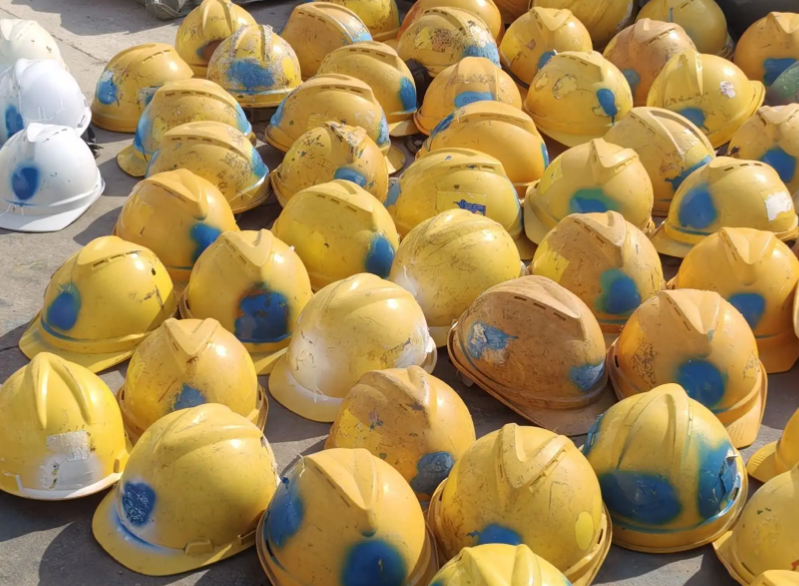
Match Feeding and Cutting to Hard-Hat Geometry
Hard hats are bulky relative to their mass and may bridge, bounce or rotate above a cutting chamber. The feed opening, hopper, grab action and operator interface matter as much as motor size. Metal clips or unexpected objects must be controlled before the trial.
A WT800 double-shaft shredder can be reviewed for bulky mixed articles where low-speed grabbing and primary size reduction are required. Final selection depends on the largest item, composition, contamination, target piece size and downstream process.
Plan Separation, Output and Safe Handling
- Define whether the goal is volume reduction, separation or material recovery.
- Remove batteries, pressurized items and prohibited contaminants.
- Identify metal, textile, foam and polymer fractions.
- Set the acceptable output size for the next handling step.
- Control dust, loose fibers and access to moving equipment.
- Confirm the lawful downstream route for each output fraction.
The acceptance test should record feeding behavior, usable output, bridging, reversals, contamination and post-test blade condition. Do not calculate return on investment from volume reduction alone.
Frequently Asked Questions
Can all PPE be shredded together?
Not automatically. Material composition, contamination, inserts, flexible parts and the downstream route may require separation before size reduction.
Why can hard hats be difficult to feed?
Their hollow curved shape can bridge or move unpredictably. Hopper and rotor engagement should be tested with representative items.
Does shredding make a hard hat recyclable?
No. Recycling also requires material identification, contamination control, separation and an approved destination for the resulting fraction.
When is a double-shaft shredder considered?
It can be reviewed for bulky mixed articles requiring strong grabbing and primary reduction before separation or further processing.
What information is needed for a PPE shredder proposal?
Send item types, materials, maximum dimensions, inserts, contamination, hourly volume, target output and downstream handling plan.
Request a PPE Material Review
Use the AMIGE inquiry page to provide representative PPE photos and the intended downstream route. We can separate feed preparation, primary shredding and material recovery requirements.