Automation Trend: Can Integrated Feeding and Weighing Systems Create a Truly Unmanned Shredding Workshop?

Taizhou Amige Machinery Co.,Ltd

Every recycling factory owner knows the daily headache. Workers push materials manually. Operators monitor feeding inconsistently. Forklifts move back and forth like nervous ants. Then somebody forgets to record production weight accurately. Suddenly, material loss appears. Production efficiency drops. Labor costs rise again. Worse still, skilled operators are becoming harder to recruit every year. I have visited workshops where expensive shredders sit idle simply because nobody is available to feed them properly. The machine is modern. The workflow still belongs to 1998.

At Amige, we believe the future of plastic recycling workshops is unmanned automation. By integrating automatic suction feeding systems, intelligent weighing modules, and centralized PLC controls, we can create continuous shredding operations with minimal human intervention. In several customer projects, labor dependency dropped by nearly 40% while material handling efficiency increased significantly. The goal is not replacing humans entirely. The goal is allowing machines to handle repetitive work more efficiently and consistently.

Some factory owners still think automation is only for giant corporations.

I disagree completely.

Even medium-sized recycling plants now need smarter production systems to stay competitive.

Especially when labor costs rise faster than machine depreciation.

Why Is Manual Feeding Becoming a Serious Problem?

Manual feeding looks simple.

Actually, it creates hidden inefficiencies everywhere.

Workers feed materials unevenly.

Some overload the shredder.

Others feed too slowly.

This inconsistency affects:

  • Rotor stability
  • Energy consumption
  • Blade wear
  • Output uniformity
  • Production scheduling

In many factories, the shredder itself is not the bottleneck.

Material handling is.

According to industrial-workflow-report, an inefficient feeding processes can reduce recycling line efficiency by more than 25%.

That is enormous.

Especially in high-volume operations.

I often joke with customers that a world-class shredder fed badly behaves like a sports car stuck behind tractors.

What Is an Automatic Suction Feeding System?

This technology has become increasingly important.

An automatic suction feeding system uses negative pressure pipelines and blower systems to transport lightweight plastic materials directly into the shredder or crusher.

No constant forklift feeding.

No manual lifting.

No mountains of loose film scattered across the workshop floor.

The system continuously transfers material through sealed pipelines.

Smoothly.

Efficiently.

Cleanly.

For materials like:

  • PE film
  • PP woven bags
  • PET flakes
  • Plastic regrind
  • Lightweight packaging waste

Automatic suction systems dramatically improve workshop organization.

They also reduce dust contamination significantly.

Research from factoery-air-control shows enclosed feeding systems can lower airborne dust levels by nearly 35%.

Operators appreciate that very much.

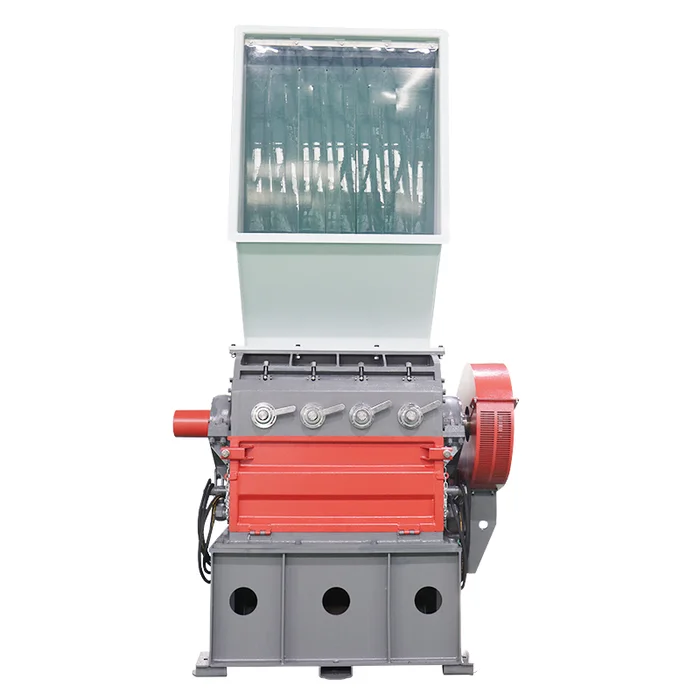
Their lungs appreciate it even more. Industrial Plastic Waste Crusher WHC800/450

Why Is Integrated Weighing Technology So Valuable?

Because factories run on numbers.

Not assumptions.

Traditional recycling workshops often estimate output manually.

That creates inaccuracies.

And inaccuracies create management problems.

Integrated weighing systems provide real-time production monitoring.

Every kilogram entering or leaving the system is automatically recorded.

This improves:

  • Inventory tracking
  • Production reporting
  • Cost analysis
  • Material loss control
  • Customer shipment accuracy

At Amige, we increasingly integrate load-cell weighing modules directly into conveying and discharge systems.

Managers can monitor production data instantly through centralized screens.

No handwritten notebooks.

No guessing.

No mysterious “missing material” conversations during monthly meetings.

Those meetings are never enjoyable.

How Does Automation Improve Shredder Performance?

This is where automation becomes more than convenience.

Stable feeding dramatically improves shredder efficiency.

Automatic feeding systems maintain consistent material flow.

That reduces sudden rotor load fluctuations.

The result is:

  • Lower energy consumption
  • Reduced knife shock
  • More stable amperage
  • Better particle consistency
  • Longer equipment lifespan

According to advanced-shredding-tech, automated feeding systems can improve shredding consistency by over 20%.

That directly affects downstream washing and pelletizing performance too.

Everything becomes smoother.

Industrial recycling is like cooking large meals.

Consistent ingredient feeding matters.

Otherwise, the entire recipe fails.

Can We Really Build an Unmanned Workshop?

Completely unmanned?

Not yet.

Let us stay realistic.

But heavily reduced labor dependency?

Absolutely.

Modern automation already allows many workshops to operate with minimal staffing.

A typical automated line may include:

  • Automatic feeding conveyors
  • Suction transport systems
  • Intelligent metal detection
  • Central PLC controls
  • Automated weighing modules
  • Full-load alarm systems
  • Remote monitoring platforms

Operators mainly supervise instead of performing heavy physical handling.

This changes the entire factory environment.

Cleaner.

Safer.

More organized.

And far less dependent on labor shortages.

In some projects, one operator can now manage multiple machines simultaneously.

Ten years ago, that sounded impossible.

Today, it is becoming normal.

Why Are PLC Systems Becoming the Brain of Recycling Workshops?

Because modern recycling lines generate huge amounts of operational data.

Without centralized control, chaos appears quickly.

PLC systems coordinate the entire process.

They monitor:

  • Motor load
  • Feeding speed
  • Rotor current
  • Production weight
  • Alarm conditions
  • Conveyor synchronization

If overload occurs, the system reacts immediately.

Much faster than human operators.

At Amige, we increasingly integrate touchscreen HMI systems with remote diagnostics.

Factory managers can monitor production performance from offices or even mobile devices.

Sometimes operators complain that machines are becoming smarter than humans.

I tell them not to worry.

Machines still cannot drink coffee or argue about football during lunch breaks.

What Financial Benefits Does Automation Bring?

This is the question every investor asks first.

And rightly so.

Automation requires upfront investment.

But long-term savings are substantial.

Reduced Labor Costs

Fewer workers are required for repetitive handling tasks.

Lower Material Waste

Automated weighing improves accuracy.

Better Energy Efficiency

Stable feeding reduces unnecessary power fluctuations.

Reduced Downtime

Automated monitoring detects problems earlier.

Higher Production Consistency

Customers receive more stable recycled material quality.

According to global-manufacturing-efficiency, automated recycling facilities often recover system investment within 2 to 4 years depending on production scale.

That timeline is becoming increasingly attractive.

Especially in regions facing labor shortages.

What Challenges Exist in Automation Upgrades?

Automation is powerful.

But implementation requires planning.

Old Factory Layout Limitations

Some workshops were never designed for automated material flow.

Pipeline routing becomes difficult.

Operator Training

Staff must learn system monitoring and PLC operation.

That transition takes time.

Initial Investment Pressure

Smaller factories sometimes hesitate because of capital costs.

Understandably so.

Material Variability

Different plastics behave differently inside automated systems.

Film behaves differently from rigid flakes.

Engineering customization matters enormously.

This is why standard “one-size-fits-all” solutions often disappoint customers.

Real automation requires process understanding.

Not just selling hardware.

Where Is the Future of Automated Recycling Heading?

The direction is very clear.

Smarter.

Cleaner.

More connected.

Future recycling workshops will likely include:

  • AI-driven production optimization
  • Predictive maintenance systems
  • Cloud-based monitoring
  • Automated sorting robots
  • Self-adjusting feeding algorithms
  • Real-time production analytics

Factories will increasingly operate like intelligent manufacturing ecosystems.

Not isolated machines.

At Amige, we are investing heavily in integrated automation because the market demand is accelerating rapidly.

Customers no longer ask only about shredder size.

Now they ask:

“How much labor can we save?”

That question defines the next generation of recycling equipment.

Why Is Automation Becoming a Competitive Advantage?

Because efficiency wins markets.

Always.

Factories with stable automation systems can:

  • Deliver faster
  • Reduce operational costs
  • Improve product consistency
  • Expand production more easily
  • Handle labor shortages better

Meanwhile, traditional workshops relying entirely on manual handling face increasing pressure.

The recycling industry is changing quickly.

Those who modernize early gain long-term advantages.

Those who wait too long often pay much more later.

I have seen that pattern repeatedly over the years.

Conclusion

Integrated suction feeding and intelligent weighing systems are transforming modern shredding workshops. In my experience, automation improves efficiency, stability, cleanliness, and profitability simultaneously. The future recycling factory will not rely on harder labor. It will rely on smarter systems working together seamlessly.