Every injection molding factory faces the same hidden challenge. Sprues, runners, rejected parts, startup waste, and color-change scrap accumulate every single day. Some factories sell this material at a low price. Others store it for weeks before reprocessing. Both approaches waste money. During my visits to injection molding plants around the world, I have seen companies invest millions in new molding machines while overlooking one of the fastest-return investments available—an inline plastic granulator. At AMIGE, we believe that recycling production scrap immediately beside the injection molding machine is one of the simplest ways to improve profitability, reduce waste, and support sustainable manufacturing.
An inline plastic granulator allows injection molding factories to recycle runners, sprues, defective parts, and startup waste immediately after production. Instead of treating plastic scrap as waste, manufacturers convert it into reusable material, reduce virgin resin purchases, shorten material handling time, and significantly lower production costs. For many medium-sized factories, these savings can easily exceed ¥300,000 per year while improving production efficiency and supporting ESG objectives.
Every kilogram of scrap already belongs to you.
The question is simple.
Will you recycle it immediately—or pay to replace it later?
Why Do Injection Molding Factories Lose So Much Valuable Material?
Injection molding is highly efficient.
Yet material loss is unavoidable.
Typical sources include:
- Sprues
- Runners
- Startup products
- Color-change waste
- Defective molded parts
- Trial production pieces
According to the Global Injection Molding Productivity Report, production scrap typically represents an important portion of material consumption in many molding operations.
The material is already purchased.
Throwing it away means paying twice.
What Is an Inline Plastic Granulator?
An inline plastic granulator, also known as a beside-the-press granulator, is installed next to an injection molding machine.
Instead of transporting scrap to another workshop, operators feed rejected parts directly into the granulator.
The recycled flakes are then:
- Collected automatically
- Mixed with virgin material
- Returned to production
- Reused in controlled proportions
Waste becomes raw material again.
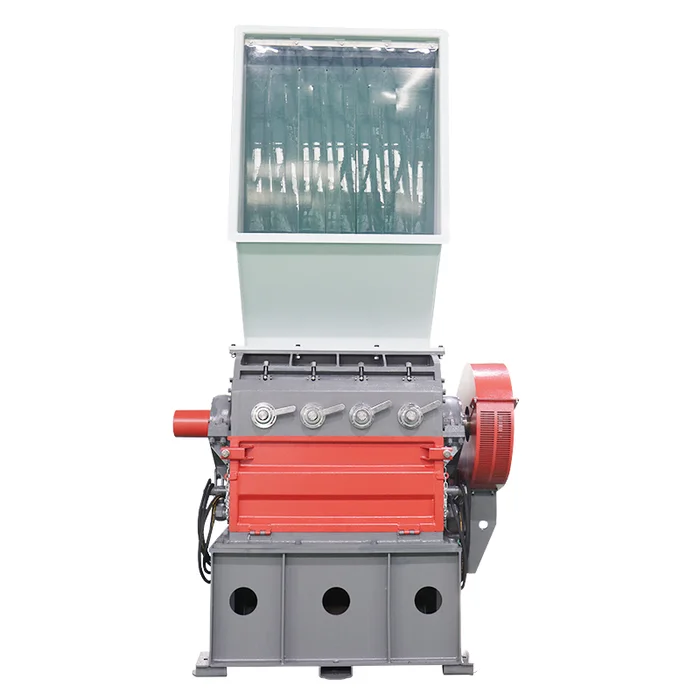
Almost immediately. Plastic Crusher WHC600/450
How Can One Machine Save ¥300,000 Every Year?
The answer lies in continuous recovery.
Consider a factory operating:
- 20 injection molding machines
- Multiple production shifts
- Daily sprue and runner generation
- Continuous manufacturing throughout the year
Instead of purchasing additional virgin resin, recovered material is reused internally.
Savings come from:
- Lower virgin resin purchases
- Reduced waste disposal
- Less material transportation
- Lower labor costs
- Faster material circulation
According to the Industrial Cost Optimization Institute, continuous in-line recycling delivers one of the fastest returns on investment in plastics manufacturing.
Small savings repeated every day become major savings every year.
Why Is Immediate Recycling Better Than Centralized Recycling?
Many factories still transport scrap to a central grinding room.
That process creates:
- Additional labor
- Material contamination
- Production delays
- Storage requirements
- Material mix-ups
Inline recycling avoids these problems.
Scrap never leaves the production area.
It goes directly back into the manufacturing process.
Efficiency increases.
Handling decreases.
What Materials Can Be Processed?
Modern inline granulators process many common thermoplastics, including:
- PP
- PE
- ABS
- PS
- PC
- PA
- PET
- POM
- PVC (selected applications)
They are suitable for processing:
- Runners
- Sprues
- Injection rejects
- Small molded parts
- Thin-wall components
Material flexibility increases equipment utilization.
How Does the Granulator Protect Product Quality?
Many factory managers worry about recycled material quality.
That concern is understandable.
Modern granulators improve consistency through:
- Uniform particle size
- Low dust generation
- Stable cutting performance
- Optimized blade geometry
- Controlled screen sizing
The Advanced Polymer Processing Laboratory reports that consistent regrind quality supports stable molding performance when appropriate mixing ratios are used.
Quality begins with consistent granulation.
Why Does Low Noise Matter?
Injection molding workshops require comfortable working environments.
Low-noise granulators improve:
- Operator comfort
- Workplace communication
- Production safety
- Regulatory compliance
Modern sound-insulated designs significantly reduce operating noise while maintaining cutting efficiency.
A quieter factory is often a more productive factory.
How Does Automation Improve Material Management?
Many inline granulators integrate with automatic conveying systems.
Recovered material can be:
- Transported automatically
- Mixed with virgin resin
- Fed directly into dryers
- Returned to molding machines
Automation reduces:
- Manual handling
- Material errors
- Labor requirements
According to the Smart Manufacturing Automation Alliance, automated material handling significantly improves production efficiency and traceability.
Automation keeps material moving.
People stay focused on production.
What Features Should Buyers Consider?
When selecting an inline granulator, I recommend evaluating:
- Rotor design
- Blade material
- Screen size
- Motor efficiency
- Noise level
- Cleaning convenience
- Maintenance accessibility
- Safety protection
- Automation compatibility
Buying the lowest-priced machine rarely produces the lowest operating cost.
The best machine creates the greatest long-term value.
How Does This Investment Support Sustainability?
Every kilogram of reused plastic reduces demand for virgin resin.
That contributes to:
- Lower material consumption
- Reduced transportation emissions
- Less production waste
- Improved resource efficiency
- Better ESG performance
The Global Sustainable Manufacturing Council recognizes closed-loop material reuse as a key strategy for improving manufacturing sustainability.
Profitability and sustainability often move in the same direction.
Why Does AMIGE Recommend Inline Granulators?
At AMIGE, we design inline granulators specifically for modern injection molding factories.
Our engineering focuses on:
- High cutting efficiency
- Low energy consumption
- Stable particle size
- Easy cleaning
- Long blade life
- Reliable operation
- Intelligent safety systems
We understand that every minute of downtime affects production.
That is why reliability remains one of our highest priorities.
What Will the Future Look Like?
Injection molding factories are becoming smarter.
They demand:
- Higher automation
- Lower material costs
- Faster recycling
- Better traceability
- Sustainable production
Inline granulators will continue evolving into intelligent material recovery systems integrated directly with Industry 4.0 manufacturing.
The future belongs to factories that recycle efficiently.
Every sprue.
Every runner.
Every opportunity.
Conclusion
An inline plastic granulator transforms production scrap into valuable raw material, helping injection molding factories reduce virgin resin consumption, improve operational efficiency, and significantly lower manufacturing costs. At AMIGE, we believe that recovering materials beside the press is not just a cost-saving strategy—it is a smarter way to build a more profitable and sustainable factory.
#InlineGranulator
#PlasticGranulator
#InjectionMolding
#PlasticRecycling
#PlasticCrusher
#InjectionMoldingFactory
#ManufacturingEfficiency
#PlasticMachinery
#MaterialRecovery
#AMIGE