The warning signs usually appear quietly.
Output drops.
Energy bills climb.
Finished material quality becomes unstable.
Managers blame labor.
Or raw material.
Or the market.
In my experience, the real problem is often sitting on the shop floor.
An outdated crusher.
Low efficiency.
High waste.
When margins shrink, inefficiency is no longer tolerable.
It becomes a liability.
High-efficiency crushers have become a business necessity because they directly determine throughput, energy cost, product consistency, and overall line profitability. In modern recycling and manufacturing, crushing is no longer a supporting step. It is a core productivity driver.
If that sounds dramatic, it should.
Crushing used to be cheap.
Now it is strategic.
Let me explain why.
I have watched many factories upgrade everything except their crusher.
Automation.
ERP.
Sorting systems.
Then they wonder why results do not improve.
The bottleneck never moved.
When Did Crushers Stop Being “Auxiliary Equipment”?
Ten years ago, crushers were simple.
Break material.
Move on.
Today, material streams are complex.
Thinner packaging.
Multi-layer plastics.
Higher contamination.
According to industry equipment surveys from plastic processing technology reports, crushing now influences over 40% of downstream efficiency losses.
That is no longer auxiliary.
That is central.
If crushing fails, everything after it pays the price.
What Does “High Efficiency” Actually Mean?
Efficiency is not speed alone.
That is a rookie mistake.
High-efficiency crushing means:
Stable throughput.
Low energy per ton.
Uniform particle size.
Minimal fines.
Studies on size-reduction performance show that energy efficiency and size consistency matter more than peak output.
A fast crusher that produces chaos is not efficient.
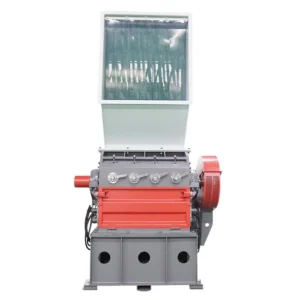
It is expensive. Plastic Grinder Waste Crusher WHC800/600
Why Energy Costs Changed the Conversation
Energy used to be background noise.
Not anymore.
Electricity prices fluctuate.
Carbon costs appear.
Audits get stricter.
In many plants, crushing alone accounts for 20–30% of total line energy use, based on recycling energy audits.
An inefficient crusher bleeds money every hour.
Quietly.
Relentlessly.
High-efficiency designs reduce load spikes.
They stabilize current draw.
They protect motors.
Energy efficiency is no longer optional.
It is financial discipline.
How Output Consistency Became a Competitive Advantage
Customers no longer buy “regrind.”
They buy specification.
Granulators need uniform feed.
Extruders demand consistency.
Quality managers track variation.
Low-efficiency crushers produce mixed sizes.
Overs.
Fines.
Dust.
Material quality data from recycled plastic quality studies shows that inconsistent particle size directly reduces extrusion stability.
High-efficiency crushers cut predictably.
Screens work properly.
Knives stay sharp longer.
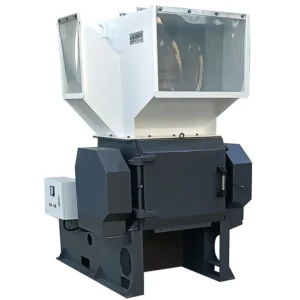
Consistency is efficiency’s quiet cousin. Plastic crusher for fabric recycling
Why Downtime Is More Expensive Than You Think
I have seen factories obsess over purchase price.
Then lose ten times that in downtime.
Knife changes.
Bearing failures.
Overheating motors.
Maintenance statistics from industrial downtime analyses consistently show crushing equipment among the top three causes of unplanned stops.
High-efficiency crushers reduce shock loads.
They protect components.
They run calmer.
Calm machines break less.
What Role Does Material Complexity Play?
Materials are not getting easier.
Lightweighting reduces stiffness.
Fillers increase abrasiveness.
Contamination rises.
Old crushers were not designed for this reality.
Material behavior research from polymer mechanical property references confirms that modern plastics require controlled cutting, not brute force.
High-efficiency crushers adapt rotor speed, knife geometry, and feed behavior.
Force alone is outdated thinking.
How High-Efficiency Crushers Support Automation
Automation hates variability.
Sensors need predictable flow.
Robots need steady feed.
Software needs stable data.
Low-efficiency crushing introduces randomness.
Smart factory case studies from Industry 4.0 recycling projects highlight crushing stability as a prerequisite for automation success.
If the first step is unstable, digital tools cannot fix it.
Automation starts with mechanics. Low Noise High-Power Crusher
Why Labor Costs Push Efficiency Up the Agenda
Labor is not cheap anymore.
And skilled labor is scarcer.
High-efficiency crushers require fewer interventions.
Fewer adjustments.
Fewer emergency stops.
Operational staffing data from manufacturing labor cost reports shows that equipment reliability directly reduces labor intensity.
Machines that behave reduce human involvement.
That is efficiency with a human face.
The Hidden Cost of Poor Crushing: Downstream Wear
Here is a fact many ignore.
Poor crushing destroys downstream equipment.
Granulators dull faster.
Screens clog.
Extruder screws wear unevenly.
Wear propagation effects are documented in plastics processing wear studies.
High-efficiency crushers protect everything that follows.
A good crusher pays dividends across the line. Plastic Crusher For Plastic Pot Crushing
Why CFOs Finally Care About Crushers
This is a recent change.
And a welcome one.
CFOs now track:
Energy per ton.
Maintenance per ton.
Downtime per ton.
Crushers sit right in the middle of those KPIs.
Financial performance benchmarks from recycling plant ROI analyses show that crusher upgrades often deliver payback faster than sorting or washing investments.
Efficiency speaks the language of finance.
Our Perspective at Amige
We have built crushers for years.
We learned the hard way.
Efficiency is not a feature.
It is a system.
Rotor mass.
Knife angle.
Cutting gap.
Frame rigidity.
We design for steady work, not showroom speed.
High-efficiency crushers disappear into operations.
That is the highest compliment.
Will High-Efficiency Crushers Replace All Others?
No.
And they should not.
Low-duty applications exist.
Temporary setups exist.
But for continuous production, high-efficiency crushing is no longer optional, as projected in future recycling equipment forecasts.
Core operations demand core equipment.
That is how industry matures.
Conclusion
High-efficiency crushers became a rigid business need because inefficiency is no longer affordable.
Energy, labor, quality, and uptime all converge here.
Ignore crushing efficiency, and the rest of the line will remind you daily.